In order to understand why grown adults wept in pubs when Scotland qualified last November, let us first tell you what football means to Scotland.
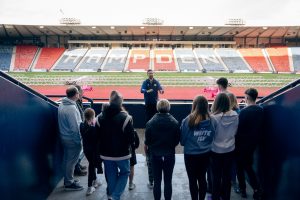 It’s hard to overstate just how deeply football is woven into Scotland’s identity. Football in Scotland isn’t simply a pastime — it’s a cultural anchor. From village parks to packed stadiums, it shapes community life, fuels local pride, and sparks stories that pass from generation to generation. Few countries have a relationship with the sport as emotionally charged or historically significant.
Here are a few facts about Scotland’s football story that are equal parts extraordinary and unfortunate…
- The world’s oldest football was discovered in the roof rafters of the Queen’s bed chamber at Stirling Castle. It has been dated to 1540 to 1570 and could have been used by Mary, Queen of Scots. Look out for the football on tour around Scotland on our social channels during the tournament!
- Scotland is the only country to be eliminated at the group stage three times on goal difference – that’s very bad luck!
- Scotland hosted the world’s first recorded women’s international match in 1881, beating England 3–0 in Edinburgh.
- The summer Scotland face Brazil for the fifth time in the group stages — a remarkable recurring fixture. Their record makes grim reading:
– Scotland have never beaten Brazil in ten meetings across all competitions.
– The two sides were also drawn together in 1998, when Scotland had the honour of opening the tournament against the defending champions in Paris. This year they meet again in Miami, in a group that also features Morocco — almost exactly recreating the 1998 draw. Some might call it destiny. Scotland fans might call it something else…
Scotland open against Haiti on June 13 in Boston, face Morocco on June 19 in Boston, and then meet Brazil on June 24 in Miami. Come on, Scotland!